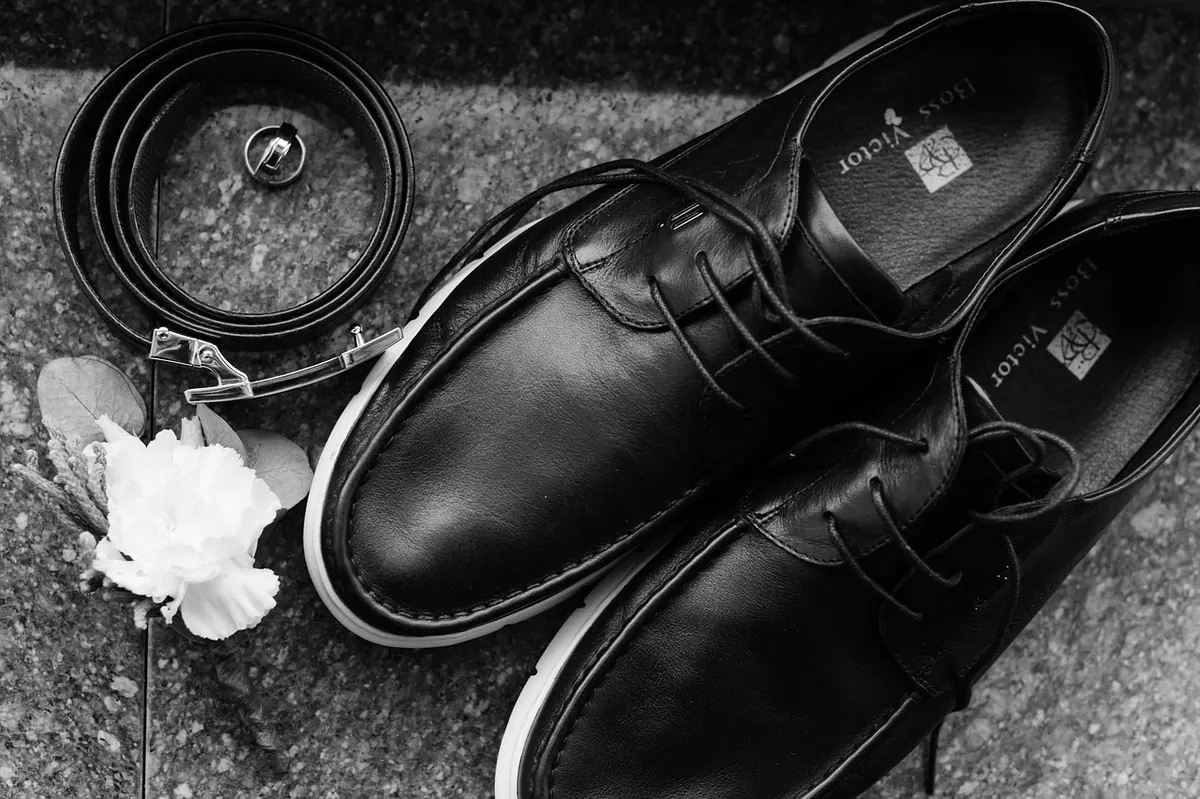
A bag, a belt, and a pair of shoes take up a small fraction of what you're wearing and do most of the talking. Coordinate them well and a plain outfit looks deliberate. Coordinate them badly and the same outfit looks accidental. The difference is rarely budget or taste. It's color logic, and it follows a handful of rules you can learn in an afternoon.
Below are five that hold up in real life, plus quick fixes for whatever is already in your closet.
Rule 1: Choose One Neutral Anchor
Every outfit with strong accessories has a base color that repeats. Black, navy, grey, brown, tan, cream, olive, burgundy, and denim blue all work. Pick one for the day and let at least two of the three pieces speak that language.
Example: navy shoes and a navy belt, with a tan bag. The bag can be a different color, but it should still be a neutral. Two neutrals read as calm. Three start to look muddy unless the tones have clear relationships to each other.
Brown deserves a warning, because it isn't one color. Chocolate, cognac, taupe, camel, and oxblood all read as "brown" but not as each other. Warm browns with an orange or red undertone sit happily together. Cool, greyish browns do too. Mixing the two camps is where things go wrong.
What Actually Counts as a Neutral
- Black, navy, charcoal — the cool backbone; these mix freely.
- Chocolate, taupe, camel, tan, cognac — warmer tones; keep warm with warm.
- Cream, ivory, stone — light neutrals that soften black and brighten navy.
- Olive, burgundy, deep forest — quiet colors that behave like neutrals in small doses.
- Gold and silver — neutral when used as hardware or a single accent piece.
Rule 2: Match the Belt to the Shoes First
This is the oldest rule in the book and it still earns its place. Belt and shoes bracket your silhouette at the top and bottom, so when they agree the eye reads a clean line through everything in between. It's especially useful with jeans, trousers, and anything tailored where the belt is visible.
Where people trip up is partial matching. A black belt with near-black shoes reads as a mistake, not a choice. If the leathers aren't identical, they need distance: either the exact same tone, or an obvious difference. A dark brown belt with light tan shoes is a look. A medium brown belt with medium-dark brown shoes is a shrug.
Either match the leather exactly or separate it clearly. The in-between is what looks accidental.
When should you break the pairing? When one piece is doing a different job. A black belt with white sneakers works because the sneakers are an intentional interruption. So does a belt that matches your bag instead — as long as the shoes bring a neutral that appears elsewhere in the outfit.
Rule 3: Let the Bag Carry the Contrast
If belt and shoes are the calm pairing, the bag is where you can afford to be loud. It's the most replaceable element of the three. You can set it down, swap it at lunch, carry it on one arm. A strong color there costs you nothing structurally.
The easiest way to pick a contrast color: take one hue already present in your outfit and repeat it in the bag. Red in a scarf, red bag. Cobalt thread in a shirt, cobalt tote. That ties the look together without introducing a new color to the story.
Keep a rough limit of three colors total — base, neutral, accent. When a bright bag, bright belt, and bright shoes all compete, none of them stands out; they cancel each other and the outfit reads as costume. One loud element, two quiet ones.
Rule 4: Go Monochrome and Let Texture Do the Work
Same color from waist to floor to hand is the most forgiving trick in this guide. Black shoes, black belt, black bag, black outfit. Navy with navy. Cream with cream. With no color contrast to distract the eye, the silhouette reads longer and leaner.
The risk with true monochrome is flatness, so vary the surfaces: polished leather shoes, a suede bag, a textured or woven belt. The eye registers the difference as depth rather than confusion. If you want a little more life, shift one tone up or down instead of matching exactly — black shoes, charcoal bag, black belt.
Rule 5: Treat Metal Hardware as a Color
Buckles, zips, clasps, studs, and chain straps act like small hits of color, and they're the detail most people forget to coordinate. Start with what you actually wear. If your rings, watch, and necklace are gold, gold hardware on your bag and belt will look like a decision. If you wear silver, go silver.
Mixing metals isn't forbidden; it just needs to look repeated rather than random. Two gold points and one silver reads as mixed on purpose. A single gold clasp floating in a sea of silver reads as an oversight. Two-tone jewelry and two-tone hardware solve the problem entirely, which is why both sell so well.
Quick Fixes for the Outfit You're Already Wearing
- Everything is dark but the belt. Swap to a dark belt or take it off. A light belt across a dark outfit cuts the body in half.
- Two browns are fighting. Commit to one family and replace the other piece with black, cream, or a matching brown.
- The bag disappears. Not wrong, but if you wanted it noticed, move to a contrast color.
- The shoes are the star. Then calm everything else — neutral bag, neutral belt, no competing pattern.
- Too many metals. Pick one finish for the day and repeat it at least twice.
The Doorway Check
Before you leave, step back three feet and squint. Look for one clear lead — the piece your eye lands on first — and two supporting players that agree with each other. If two things are fighting for attention, remove one, and the belt is usually easiest to lose. If nothing stands out at all, add a single contrast, and the bag is the safest place to put it.
These aren't laws, just defaults you can break knowingly. Match, separate, or contrast — the goal is simply to look like you meant it.
Photo: Taniiia / Pixabay